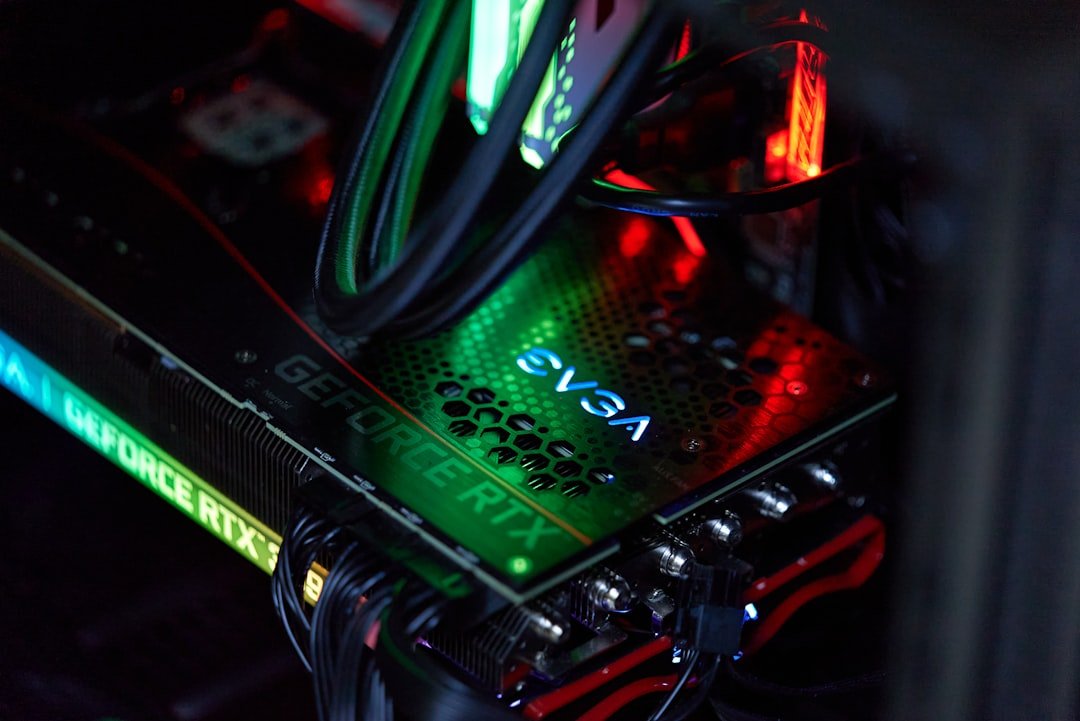

Nvidia’s shares pierced $200 this week, capping an 11-session winning streak and validating investors who held firm through months of choppy trading, as AI demand surges across enterprises and sovereign nations alike. The rally, powering the S&P 500 toward fresh highs above 7,000, reflects not just market rotation into megacap tech but Nvidia’s deepening entrenchment in inference-heavy workloads and emerging frontiers like quantum computing. With revenue projections soaring toward $480 billion by fiscal 2028—fueled by hyperscaler capex and “AI factories” for data sovereignty—the company’s fundamentals signal a potential path to $300 per share, trading at a forward multiple that appears reasonable given 20%+ annual growth forecasts.Nvidia stock breakout analysis Bullish revenue outlook
This momentum coincides with Nvidia’s technical salvoes: open-source AI models accelerating quantum error correction, GPU-optimized tools for video pros, and cloud gaming expansions that extend its CUDA ecosystem into consumer and enterprise edges. These moves matter because they shift AI from hype to scalable infrastructure, where Nvidia’s moat—proprietary software locking in workloads—confronts rivals like AMD and custom silicon from hyperscalers. As enterprises grapple with total cost of ownership (TCO) in token factories, Nvidia’s innovations promise lower costs per inference output, reshaping cloud economics and cybersecurity postures reliant on accelerated compute.
Stock Surge Validates AI’s Shift to Inference and Sovereignty
Nvidia’s stock climb to $197, up 75% over the past year, stems from a pivotal transition: from episodic training runs to perpetual inference demands. Analysts highlight agentic AI—systems that generate exponentially more tokens per task—as the catalyst, with Nvidia’s Vera Rubin architecture optimizing latency and output per megawatt. This isn’t mere speculation; fiscal 2026 revenue hit nearly $216 billion, up from $27 billion in 2023, with sovereign AI adding a new pillar as nations build domestic “AI factories” to safeguard data.Revenue growth drivers
For enterprises, the implications are profound. Hyperscalers like Microsoft, locked into CUDA-optimized codebases, face prohibitive switching costs, ensuring Nvidia’s 80-90% GPU market share endures. Sovereign demand could mirror hyperscaler capex at $690 billion annually, targeting national security and compliance. Yet risks loom: tariff shifts on metals could pressure supply chains, echoing industrials’ 2% drop in Dover and Eaton. Investors betting on $300/share see 50% upside if inference scales as projected, but execution hinges on Rubin deliveries amid U.S.-Iran tensions. This resilience underscores Nvidia’s role as the AI infrastructure backbone, where patience indeed pays dividends.Market rotation insights
Quantum Computing’s Rally Fueled by Nvidia’s Ising Models
Quantum stocks exploded this week—IonQ and D-Wave up over 50%, Rigetti and Quantum Computing over 30%—after Nvidia unveiled Ising, a family of open-source AI models tackling quantum’s Achilles’ heel: error correction and calibration. Named for the mathematical model underpinning spin glasses, Ising positions AI as the “control plane” for quantum machines, transforming “fragile qubits to scalable and reliable quantum-GPU systems,” per CEO Jensen Huang.Ising announcement details
Technically, this hybrid approach leverages Nvidia GPUs for high-performance error mitigation, critical for fault-tolerant quantum systems. Current Noisy Intermediate-Scale Quantum (NISQ) devices suffer decoherence; Ising’s tools enable practical hybrid-classical setups, accelerating adoption in drug discovery, optimization, and cybersecurity simulations. For cloud providers, it means quantum-as-a-service atop existing NVIDIA infrastructure, lowering barriers versus pure-play quantum firms.
Business-wise, Nvidia democratizes quantum via CUDA-Q, outpacing IBM’s Qiskit or Google’s Cirq in ecosystem scale. Unveiled on “World Quantum Day” (4.14, nodding to Planck’s constant), this bolsters Nvidia’s enterprise pivot: quantum-enhanced AI for logistics or finance could slash compute costs 10x in targeted apps. As quantum hype matures into hybrid reality, Nvidia cements its supremacy, blending classical GPUs with nascent qubits to future-proof data centers.
Gaming Ecosystem Expands with PRAGMATA and GeForce NOW
Capcom’s sci-fi blockbuster PRAGMATA launches April 17 on GeForce NOW, streaming ray-traced visuals and DLSS 4 tech to any device—no high-end rig required—alongside Fortnite’s free “Save the World” mode. A dedicated Game Ready Driver adds path tracing, DLSS Multi Frame Generation, and Ray Reconstruction, while Windrose and Neverness to Everness updates bring Reflex low-latency.PRAGMATA launch support GeForce NOW integration
This extends Nvidia’s cloud gaming moat into enterprise-adjacent realms like virtual training sims. DLSS 4 boosts frame rates 4x via AI upscaling, critical for edge devices in industrial IoT or AR/VR workspaces. For cloud operators, GeForce NOW’s Ultimate tier beta in India signals global scale, reducing capex for game devs while feeding inference pipelines.
Implications ripple to cybersecurity: low-latency streaming secures remote access without local vuln exposure. As gaming blurs into metaverse enterprise tools, Nvidia’s 90% discrete GPU dominance translates to cloud revenue streams, pressuring Microsoft Azure or AWS GameLift.
Professional Workflows Supercharged: Adobe Premiere’s GPU Leap
At NAB Show 2026, Adobe’s beta Premiere Color Mode—nested grading in 32-bit depth—harnesses RTX GPUs for bidirectional controls and six-zone luminance mapping, slashing iteration times in post-production. NVIDIA’s Project G-Assist update further tunes RTX systems via AI.Premiere acceleration
Compute-intensive grading, once bottlenecked by CPU, now thrives on tensor cores, enabling real-time feedback for 8K workflows. Enterprises in media clouds gain efficiency: faster exports cut cloud bills, vital as video AI (e.g., auto-edits) surges.
This cements RTX in creative pipelines, challenging Apple’s M-series in pro apps. Broader: it previews AI agents in content ops, integrating with Omniverse for virtual production—lowering TCO for broadcasters amid streaming wars.
AI Infrastructure’s New North Star: Cost per Token
Nvidia reframes AI TCO around “cost per million tokens,” dismissing FLOPS/dollar for output-focused metrics. Token factories prioritize inference; optimizing denominator (tokens/GPU-hour) via software yields lowest industry costs.Token economics breakdown
Equation: (GPU-hour cost) / (tokens/second). CUDA-X stack boosts utilization 2-3x, extending to sovereign factories. Enterprises save 30-50% versus rivals, scaling agentic AI profitably—key for cloud margins as inference hits 80% of workloads.
Competitively, this buries Broadcom’s ASICs; ecosystem lock-in wins.
Partnerships and Rumors: Ecosystem Resilience Shines
Nvidia feted EMEA partners like Accenture (Consulting) and TD SYNNEX (Distributor) for scaling AI factories and Omniverse twins, as Akila pioneers real estate sims.EMEA awards Amid this, Nvidia quashed PC acquisition rumors involving Dell/HP, whose shares whipsawed 5-7% before denial, affirming focus on chips over systems.Rumor denial
Partners amplify reach: Accenture’s sovereign AI deployments hit production, buffering U.S.-China tensions. This ecosystem—$70B invested FY26—drives 20% CAGR, insulating against single-vendor risks.
These threads weave Nvidia’s fabric: financial firepower funding quantum-gaming-AI synergies, where cost-per-token economics propel enterprise adoption. As Rubin and successors roll out, hyperscalers and sovereigns alike will lean harder on CUDA, potentially eclipsing $1 trillion market cap. The question lingers: can rivals fracture this hegemony before inference ubiquity locks it in for the decade?