
Samsung Electronics’ $200 billion memorandum of understanding with Broadcom marks a decisive step in the foundry wars, anchoring long-term production of next-generation AI accelerators and high-bandwidth memory at Samsung’s fabs. The agreement, spanning memory chips, contract manufacturing and advanced packaging through 2030, arrives as hyperscalers and chip designers increasingly favor custom ASICs over off-the-shelf GPUs. By securing Broadcom’s commitment, Samsung gains both revenue visibility and a high-profile reference customer that can help close the utilization gap with market leader TSMC.
The timing is equally telling. Samsung’s foundry business has trailed TSMC in advanced-node yields and customer wins for years; landing a multi-year pact valued at roughly $200 billion supplies both financial ballast and technical momentum. The deal explicitly calls for Broadcom’s communications chips to be fabricated on Samsung’s sub-2-nanometer process, while the two companies will jointly develop next-generation HBM stacks. These elements position Samsung inside the custom-silicon wave reshaping AI infrastructure.
Securing a Seat at the Custom AI Table
Broadcom’s decision to expand its relationship with Samsung reflects a broader industry shift toward application-specific silicon. Rather than relying solely on general-purpose accelerators, cloud providers and enterprises are designing chips tailored to inference, networking and memory hierarchies. Samsung’s statement emphasized its ability to deliver “end-to-end semiconductor technologies across an increasingly diverse range of AI and high-performance computing applications,” underscoring the integrated-memory-plus-logic pitch it now offers.
The partnership also includes collaboration on next-generation HBM products, a critical bottleneck for training and inference clusters. By coupling its foundry capacity with HBM roadmaps that stretch toward HBM4E and HBM5, Samsung is attempting to replicate the system-level advantages TSMC has built with advanced packaging. Whether the Korean firm can match TSMC’s CoWoS or InFO yields at scale remains an open question, but the Broadcom commitment provides a multi-year runway to close that gap.
Reconfiguring the Foldable Experience
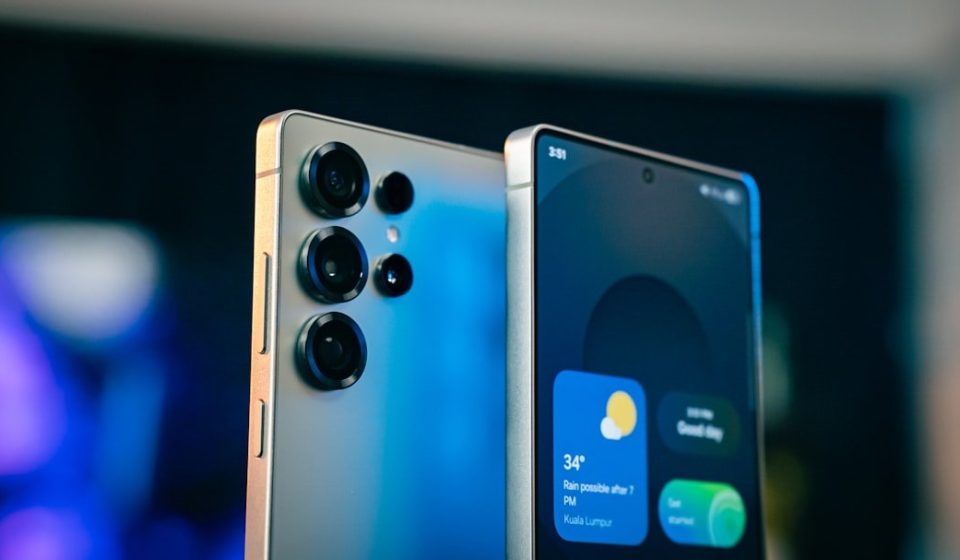
Parallel to its semiconductor push, Samsung has refreshed its entire foldable portfolio, introducing both incremental refinements and a new “passport” aspect ratio in the Galaxy Z Fold 8. Early hands-on reports indicate that the squarer inner screen improves one-handed use and typing ergonomics while delivering a more natural 4:3 canvas for productivity tasks. The trade-off appears in media consumption, where vertical content produces black bars on the cover display and landscape video encounters letterboxing on the inner panel.
These design choices matter because foldables are no longer niche experiments; they are becoming meaningful revenue contributors. Samsung’s willingness to iterate on form factor—rather than simply scaling up last year’s model—signals that the company views foldables as a long-term platform rather than a single-generation novelty. The software optimizations accompanying the new aspect ratio, including a refined keyboard layout and multitasking shortcuts, further suggest that hardware and interface are being co-engineered to serve both content consumption and creation.
Ultra Ambitions and Pricing Realities
The newly announced Galaxy Z Fold 8 Ultra carries a starting price of $2,099.99, a $100 increase over its predecessor, yet early benchmarks show meaningful upgrades in thinness, battery endurance and camera hardware. The device ships with a Snapdragon 8 Elite Gen 5 for Galaxy chipset, up to 16 GB of RAM and a 5,000 mAh cell supporting 45 W wired charging. At 4.1 mm when unfolded, it is the thinnest book-style foldable Samsung has produced, addressing a persistent complaint about bulk.
The Ultra’s positioning reveals Samsung’s tiered strategy: the standard Z Fold 8 targets users seeking a more compact profile, while the Ultra courts power users willing to pay for marginal gains in display real estate, thermals and imaging. Whether the price elasticity exists at the top end will depend on how compelling the productivity features prove in daily workflows. Initial reviews note that the 3:4 inner aspect ratio improves document editing and split-screen multitasking, yet the $2,099 entry point still invites direct comparison with high-end laptops and tablets.
Flip Line Tightens Its Focus
Samsung simultaneously unveiled the Galaxy Z Flip 8, priced from $1,199.99. The new model trims thickness to 6.1 mm when open and reduces weight to 180 grams, making it the lightest flip-style foldable the company has shipped. Display sizes, RAM and battery capacity remain unchanged from the prior generation, indicating that Samsung is prioritizing refinement over reinvention in the clamshell segment.
The strategy appears sound: the Flip line has already achieved broader mainstream adoption than book-style devices, and incremental improvements in portability and hinge durability can extend that lead without requiring wholesale redesign. Early availability on August 7 will test whether consumers view the $100 price increase as justified by the slimmer profile and Snapdragon processor continuity.
Ecosystem Glue: Customization and Cohesion
Beyond smartphones, Samsung is encouraging deeper personalization through tools such as Watch Face Studio, which allows Galaxy Watch owners to replicate analog designs from heritage timepieces. The availability of a no-cost development environment that supports commercial distribution on the Play Store lowers the barrier for third-party creators and strengthens the Wear OS ecosystem around Samsung hardware. While seemingly modest, these touches reinforce platform stickiness across the company’s expanding device family.
Taken together, the Broadcom agreement and the refreshed foldable lineup illustrate Samsung’s dual-track approach: securing upstream semiconductor relevance while tightening downstream product differentiation. The coming quarters will reveal whether custom-ASIC demand materializes at the scale projected and whether consumers accept the new foldable ergonomics at premium prices. What is already clear is that Samsung is no longer content to trail in either arena.